
 Culture
Lobos 2026 archaeological campaign identifies lime kiln opposite Roman purple-dye workshop
Excavations at Lobos 5, on Playa de La Calera, covered three areas and opened up new lines of research. The kiln’s date has yet to be established.
Redacción
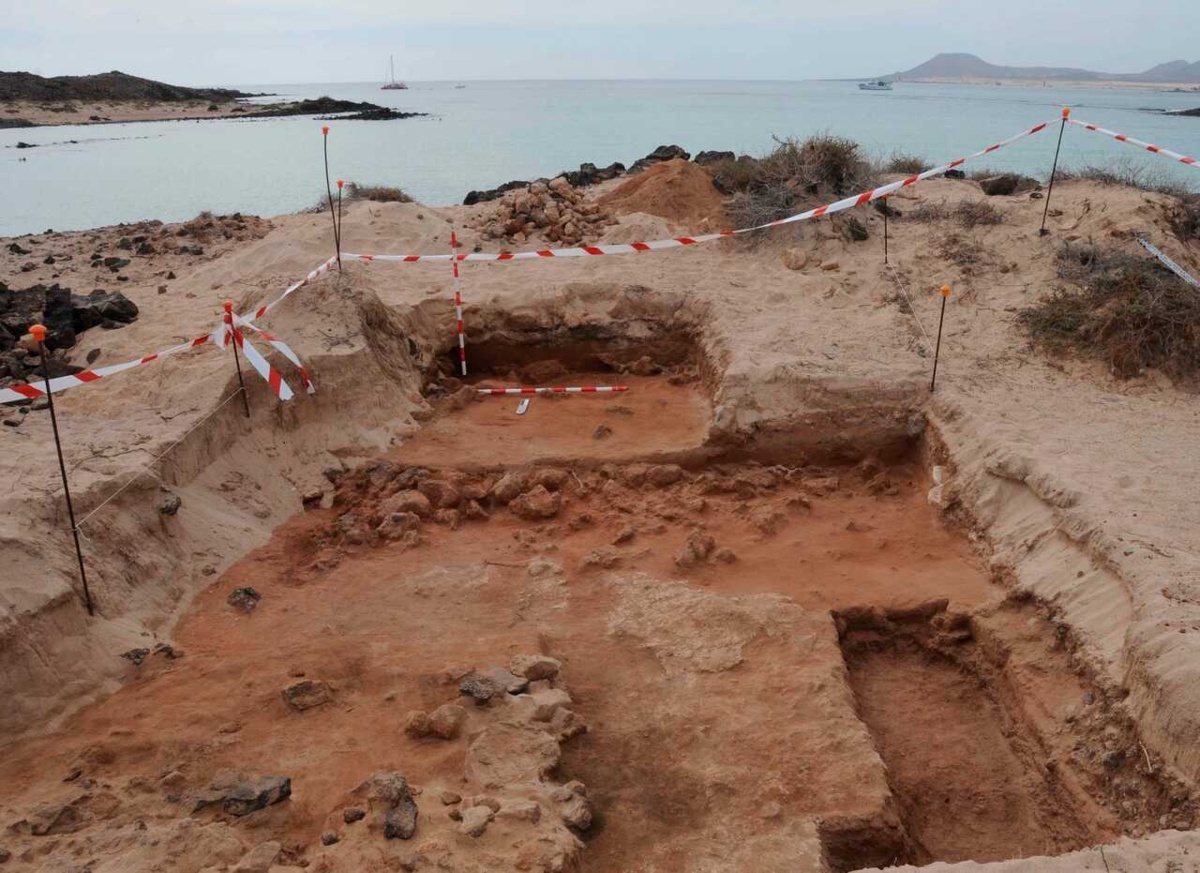
The 11th archaeological excavation campaign on the islet of Lobos has concluded with the identification of a lime kiln at the Lobos 5 site, on Playa de La Calera. The site lies on a small promontory opposite Lobos 1, where the Roman purple-dye workshop is located. The work, which began on 25 October, focused on three areas and documented a space partly associated with lime production.
The campaign is being carried out under an agreement between the Fuerteventura Island Council, through the Fuerteventura Archaeological Museum, and the Tenerife Island Council, through the Autonomous Organisation of Museums and Centres and the Tenerife Archaeological Museum. The multi-year project is co-directed by Isidoro Hernández Sánchez, Mercedes del Arco Aguilar and María del Carmen del Arco Aguilar. The team includes archaeologists and specialists from the University of La Laguna, the Fuerteventura Island Council’s Topography Service and the Tenerife Museum of Natural Sciences.
Rayco León, Councillor for Historical Heritage, said: “Lobos continues to show that the islet holds much more than meets the eye. This campaign has uncovered a working area linked to lime and raised new questions that can only be answered through further work and excavation. That continuity, which we are pursuing alongside the Tenerife Island Council and the University of La Laguna, is what allows us to piece together the islet’s history.”
The archaeologists first excavated what was thought to be a lime kiln, which had collapsed and been covered by sand. The excavation covered around 98 square metres, both outside and inside the structure, which could not be fully excavated. It revealed a kiln with no external buttresses and a central circular body that becomes horseshoe-shaped as its inner walls narrow towards the opening. No archaeological material was found in the debris or nearby that could link it to a particular culture.
In a second area, covering 20 square metres southwest of the kiln and close to its opening, the team identified a combustion feature and, beneath it, a large lime crust. These may correspond to one of the kiln’s emptying or cleaning episodes. No associated materials were found here either.
The third area, covering 16 square metres to the northwest, revealed a deposit of stones beneath the sand. Some were aligned along a course that may mark the base of a wall. The deposit includes a clearly defined circular space and a triangular stone with a perforation in one face, set upright and firmly wedged in place. Its interpretation remains open: the excavated area will need to be extended to provide an overall view of these structures.
The team is certain that the Romans settled on Lobos needed lime, both for the mortar in the walls of the purple-dye workshop at Lobos 1 and for the dye-production process, although other alkaline substances may have replaced or supplemented it in the latter. The kiln has some distinctive construction features, perhaps archaic ones, that could help date its construction. However, the researchers do not rule out the possibility that it belongs to a more recent historical period. Dating the lime crust and combustion remains will help establish the date of one of its periods of use, probably the most recent.
Even before those results are available, the team considers the heritage value of the kiln and adjacent areas “unquestionable”. Remains of human activity have also been identified nearby, including shell material, pottery and possible wall structures, which will be studied in future excavations. Lobos 5 therefore adds to and broadens the cultural heritage of Playa de La Calera.
The project directors thanked the participating institutions for their involvement, Binter for transporting the team and materials, Environment workers, and everyone who contributed to the excavation or visited to learn about it.
Source: La Voz de Fuerteventura

