
Carlos Bardem urges people in Fuerteventura to vote and defends culture against fascism
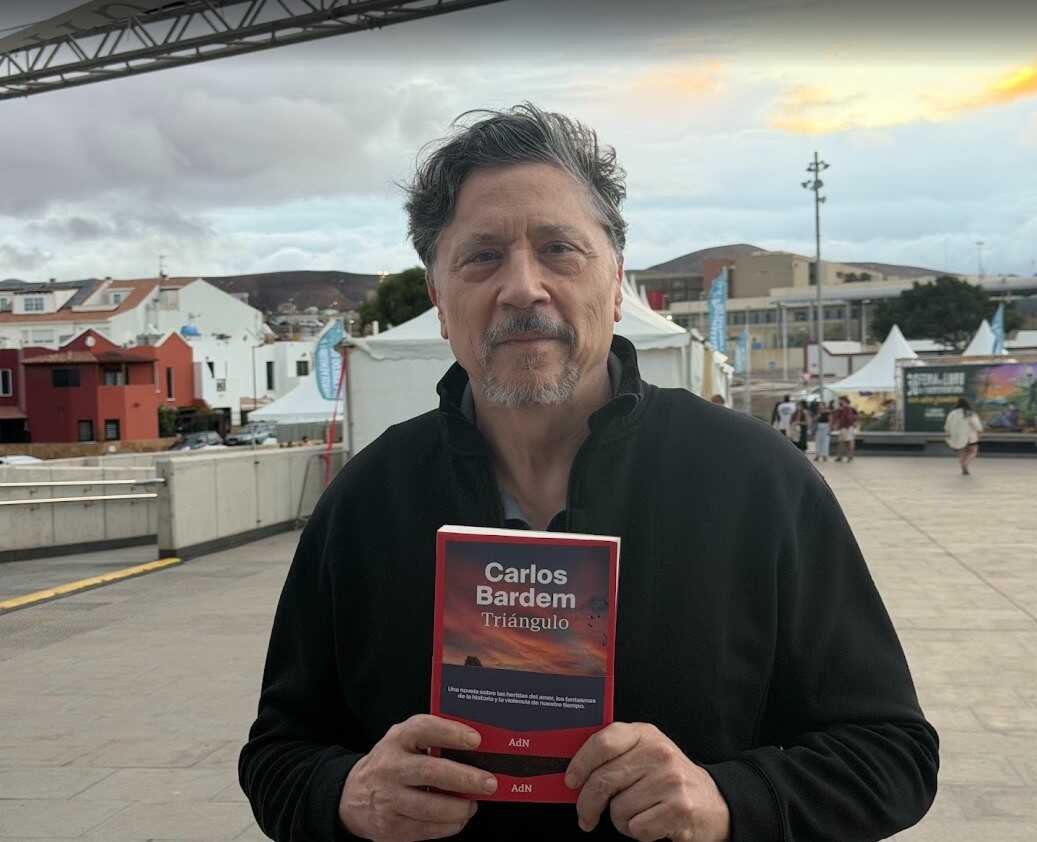
Carlos Bardem presents his novel Triángulo at the Fuerteventura Book Fair, champions culture as a “bulwark against fascism” and warns of the importance of the 29 November elections.
“Culture, when it is culture, has to be committed”
“The politics of evil that the far right rides on must be fought by every means available to us. And one of those is the vote.” These are the words of actor, writer, historian and activist Carlos Bardem, who was in Fuerteventura on Sunday to present his latest novel, Triángulo, his seventh novel and ninth literary work.
Referring to philosopher Emmanuel Levinas, who defined evil as “the justification of another person’s suffering”, Bardem urged people to take part in the elections and defend democracy in a vote he described as “almost constituent”. He believes that polling day on 29 November will mean “opening the door to fascism or closing it for good”.
Bardem sees literature as an exercise in social responsibility and rejects the idea that creators should keep out of political conflicts.
“I believe culture, when it is culture, has to be committed, especially in the times we are living through, with fascism on the rise again,” he said.
He added that writers must, at some point, address the wound left by the Civil War and Francoist repression. The wound remains open, he stressed, and is reflected in his new novel, set in Extremadura, where the Badajoz massacre took place and General Yagüe’s column of rebel troops advanced in a bloody campaign, followed by what Bardem described as “extremely cruel” repression.
He was unequivocal in criticising what he sees as the failure of the Historical Memory Law, as well as the absence of teaching about Spain’s own history in schools.
Mari Carmen, a symbol of failure and resistance
The novel opens with its protagonist in central Madrid, living in a building undergoing constant renovation as properties are turned into lucrative tourist flats and tenants are driven to the outskirts.
The issue has come into sharp focus in recent weeks following the eviction of the elderly Mari Carmen, who died shortly afterwards in hospital.
For Bardem, Mari Carmen represents social failure, but also a model of resistance taking to the streets. Rent-seeking, extractive capitalism has condemned entire generations of citizens to precariousness, he said, “and at some point this had to explode—and it has”.
The people camping in Madrid’s Plaza de Sol, with similar camps elsewhere in the country, are “teaching us that politics often gets lost in the noise of institutional politics, and that real politics happens in the streets, in neighbourhoods and in associations”, the author said.
He stressed that the protests are a response to the deteriorating living conditions of a significant part of the population. “People can’t live. They are being forced out of their homes and are unable to find a home at a reasonable price.”
For Bardem, this resistance is a reason for optimism and suggests that “something important” will happen on 29 November. “I’m very optimistic,” he stressed. “Pessimism is reactionary.”
Triángulo
Triángulo also explores issues including desire, ageism, machismo and violence.
The story centres on three main characters: a writer who considers himself a feminist but acknowledges his own machista behaviour, and two women from different generations—a grandmother and her granddaughter—who are independent and strong-willed.
The three meet at a literary retreat in a country estate in Extremadura. Their relationships form a triangle of attraction, conflict and reflection on desire, ageism and the boundary between thought and action.
Bardem explores these three-way relationships while insisting that his political commitment does not mean compromising his standards as a writer. “I don’t give up on the quality of the writing or the beauty of what I write,” he said, expressing the hope that readers will find the book beautiful and poetic, an important work that has made them reflect.
Carlos Bardem presented Triángulo at the Fuerteventura Book Fair, accompanied by journalist Manu Riveiro, before a large audience. He urged them to read and defend culture, “which must be a bulwark against fascism”, he concluded.
Source: La Voz de Fuerteventura