
Vanesa Frahija (CCOO): “The Canary Islands are growing faster than the European average, but still have Spain’s lowest wages”
In Fuerteventura, CCOO Canary Islands general secretary Vanesa Frahija has called for the islands to “grind to a halt” on 11 November, with a general strike demanding solutions to the housing crisis, decent wages and greater social protection. The strike, called by CCOO, UGT and the Tenants’ Union, has drawn support across the islands from other unions, including Intersindical Canaria and CGT. Frahija insists, however, that the action must go beyond union labels and bring together the entire working class. “This is no time for labels,” she says, looking ahead to a day that will also include a demonstration in Fuerteventura, scheduled for 17:30 on the day of the strike.
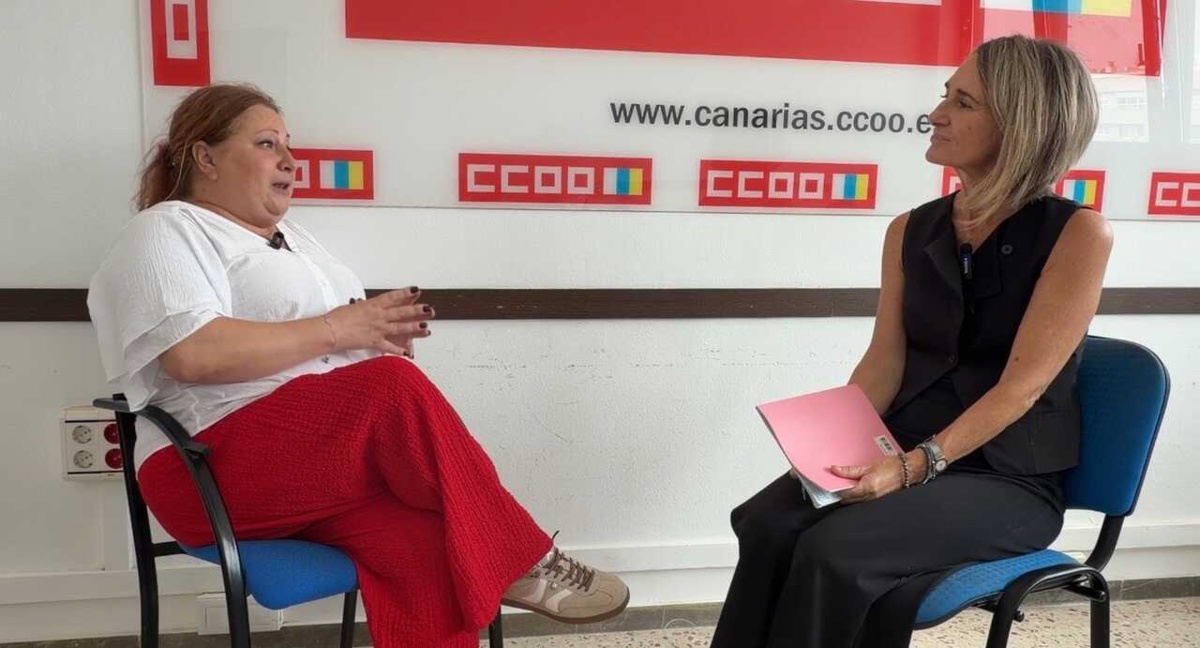
Vanesa Frahija, general secretary of Comisiones Obreras in the Canary Islands, said in an interview with La Voz de Fuerteventura on Monday that a general strike was needed to bring economic activity across the archipelago to a halt on 11 November.
The union leader says it is unjustifiable that the Canary Islands should have Spain’s lowest wages while recording economic growth above the European average.
“We cannot accept that we still have the lowest wages in Spain,” Frahija stresses. She acknowledges that wages have improved in recent years, but insists those gains are insufficient in the face of rising housing and food costs. Vanesa
Housing is one of the main drivers behind the strike. “Between 70 and 90% of our wages go towards paying rent,” she says, describing a situation that affects young people as well as workers of other ages.
Frahija directs much of her criticism on this issue at the Canary Islands Government, which she accuses of failing to use the measures provided for in national housing legislation, particularly the designation of rent pressure zones.
She also questions the regional government’s calls for funding to build homes while, in her view, it is not taking sufficient action to intervene in the rental market.
The union representative notes that the Government itself has referred to around 211,000 empty homes in the Canary Islands. She asks what steps have been taken to establish which are habitable and could be added to the housing market.
CCOO is calling for an expansion of public housing and affordable rents. It also supports providing legal certainty for small landlords and rejects the criminalisation of tenants.
Asked in the interview about the central government’s handling of housing and its rush to approve housing decrees at the end of its term, Frahija acknowledges that the Government “has rushed” its latest initiatives.
However, she declines to elaborate on her criticism and defends the coalition government’s social progress, particularly the increase in the national minimum wage and labour reform.
CCOO asserts its left-wing stance and warns of setbacks under the PP and Vox
The interview also addressed the fact that the general strike is close to the 29 November elections. Frahija rejects the suggestion that the strike is driven by electoral interests, noting that the Tenants’ Union had already called for mobilisation after the housing decrees failed to pass in Congress, before the election was called.
She also stressed that the organisation is a socio-political union, as set out in Article 7 of the Spanish Constitution. “And of course we are a left-wing, progressive union,” she said, making clear that CCOO does not intend to remain ideologically neutral.
The union leader warns that a government led by the People’s Party (PP) and Vox would, in her view, reverse progress, particularly on collective bargaining, union representation and workers’ rights. She also voiced concern about possible cuts to public services and social advances.
Frahija argues that both parties aim to weaken unions’ bargaining power and promote individual employment relationships between companies and workers.
“With a right-wing and far-right government, we will get exactly the opposite,” she warns, referring to the social and labour advances her organisation supports.
“Bring the islands to a halt” and move beyond union labels
“The strike must be supported to bring the country to a halt and, in this case, we are taking that to our territory and bringing the islands to a halt,” the general secretary says.
She insists that the action must go beyond union labels. “This is no time for labels,” she says, arguing that everyone is part of the same working class and needs to “say enough is enough”.
The aim, she explains, is to coordinate efforts, routes and schedules so that the protests attract the greatest possible turnout across the islands.
CCOO is preparing for the day with visits to workplaces, shops, hospitality businesses, ports and industrial estates. Between 3 and 6 November, it will hold assemblies with its union representatives on the different islands.
In Fuerteventura, the strike will begin at 00:00 on 11 November. Informational pickets will be held during the day, and a demonstration is planned for 17:30.
The call is also directed at pensioners, young people and those who are not working, with the aim of turning the protest into a broad citizens’ mobilisation, the general secretary says. “There’s no doubt that thousands of people will take to the streets, because this can’t be allowed to continue,” Frahija says, urging organisations to put their differences aside so that on 11 November they can be “one voice of the people across the whole Canary Islands”.
Source: La Voz de Fuerteventura