
Albi: What grows in Fuerteventura is served in Fuerteventura
Albi: What grows in Fuerteventura is served in Fuerteventura.
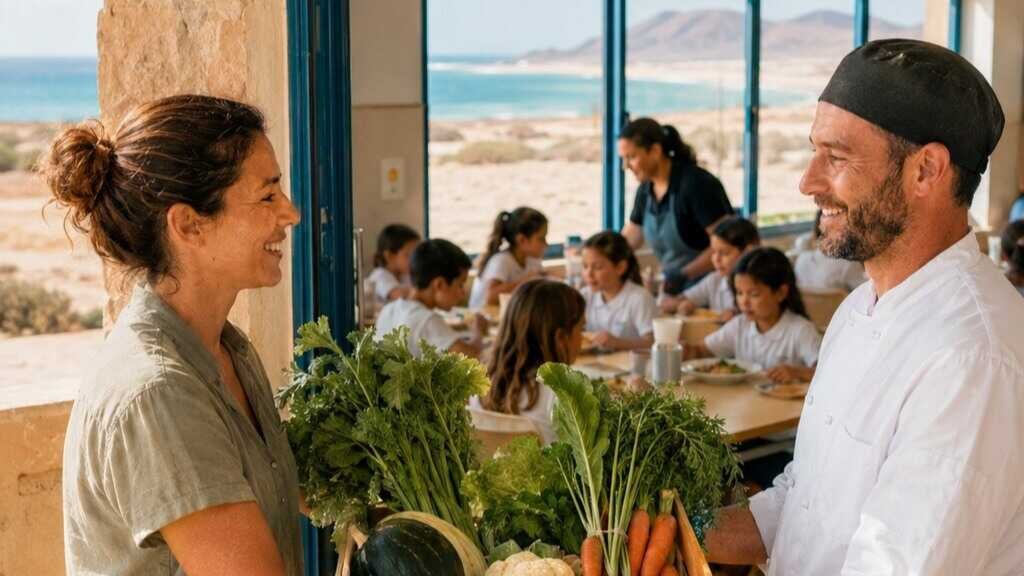
Behind every meal served at a school or health and social care centre in Fuerteventura lies a question that almost nobody asks at the table: where does the food on the plate come from? For Albi Canarias, answering that question is the foundation of its entire contract catering model on the island. It is not just a neat line in a sustainability report. It is a practical way of buying and working that has a real impact on Fuerteventura’s economy, environment and daily life.
Not all the money generated by a school canteen stays in the same place. On an island such as Fuerteventura, where the economy depends largely on services and logistics follow their own rules, every purchasing decision in contract catering pushes in one of two directions: towards local development or towards resources flowing away. Above all, the supplier’s location determines which way things go.
Money that stays in Fuerteventura
Behind the 90% to 95% of supplies Albi Canarias buys in Fuerteventura, sourced from the island itself, Lanzarote or Gran Canaria, are specific businesses and farms. Farmers, livestock producers, fishermen and distributors who, thanks to contract catering, have a stable customer, substantial orders and purchasing plans made in advance. For quite a few small island producers, that regular contract is simply what makes it viable to keep producing.
The mechanism is straightforward, but its effect is considerable. If a contract caterer buys from outside the island, that money leaves and does not come back. If it buys in Fuerteventura, by contrast, the money stays, circulates and ultimately strengthens the island’s productive base. Every meal served at a school quietly sets a small chain of local producers, transport operators and distributors in motion. It is one of the least visible effects of the model, and at the same time one of the most significant.
Fresher food, with less lost along the way
The less time that passes between harvest and plate, the better an ingredient’s nutritional value is preserved. That is precisely what locally sourced produce offers: it arrives sooner and is handled less. In a school dining hall serving hundreds of meals a day, that advantage means a higher-quality ingredient. Seasonal fruit and vegetables from the Canary Islands cannot compete with the prices offered by large distributors on the Spanish mainland, but they do win on freshness, traceability and the consistency of an offering designed to feel close to home.
There is also a second advantage that is rarely mentioned alongside freshness: the transport footprint. A shorter supply chain means less transport, less packaging and fewer emissions. And at a time when environmental sustainability is not just a regulatory requirement but something families take for granted, choosing produce from the islands adds an environmental dimension that carries weight.
Flavours pupils recognise as their own
But this story is not all about logistics or figures. When a school menu brings back a stew, chickpeas or fresh fish from the island, the dining hall becomes more than a place to eat: it becomes a place where pupils recognise something of their own. The dish does more than nourish them; it also teaches younger children where their food comes from, who produced it and why this food culture is worth preserving.
Albi Canarias’ team of dietitians and nutritionists always keeps one principle in mind: a perfect menu on paper is no use if nobody eats it. That is why they design menus to balance nutrition and food safety without losing sight of the need for each dish to be appealing. Experience shows that pupils eat better, and more, when they recognise the flavours, find the food familiar and see ingredients that are part of their own island’s culinary tradition.
Fuerteventura’s producers: partners, not just suppliers
For a producer in Fuerteventura, selling to a contract caterer based on the island is not the same as securing a one-off order. It means having a customer, school year after school year, who plans ahead, buys regularly and knows the area first-hand. And on an island where the primary sector is struggling to hold its ground against pressure from tourism and competition from outside, this kind of relationship offers something in short supply: stability.
The impact extends beyond suppliers. Albi Canarias also creates direct employment on the island in cooking, school meal supervision, coordination and management. These are jobs that do not depend on the tourist season that shapes the rest of the island’s economy. In a place where services carry so much weight, the employment stability linked to school catering is no small matter.
A decision that makes a difference on several fronts
None of this is a passing trend or an image-building strategy. It is a structural decision that brings economic, environmental, nutritional and cultural benefits, which grow stronger the longer it is sustained. And when the decision is made by a 100% Canarian company, managed from within the territory, its impact is more than symbolic: it multiplies.
In Fuerteventura, Albi Canarias does not run its dining halls from a distant office. It manages them from within, with teams working on the island, suppliers who are part of the same productive ecosystem and menus that engage with Fuerteventura’s gastronomic tradition. More than a business model, this is a practical way of understanding the responsibility contract catering has towards the territory in which it operates.
Ultimately, when local produce reaches the plate of a child at a school in Fuerteventura, it is more than just a meal being served. It is also a commitment to the island.
Source: La Voz de Fuerteventura